
Serving Scotland: our five-year plan
This is the civil service of the Scottish Government's five-year change plan, setting out how it will evolve and improve from 2026 to 2031, to support ministers serve the people of Scotland.
The plan
This is our organisation’s plan for change from 2026 to 2031.
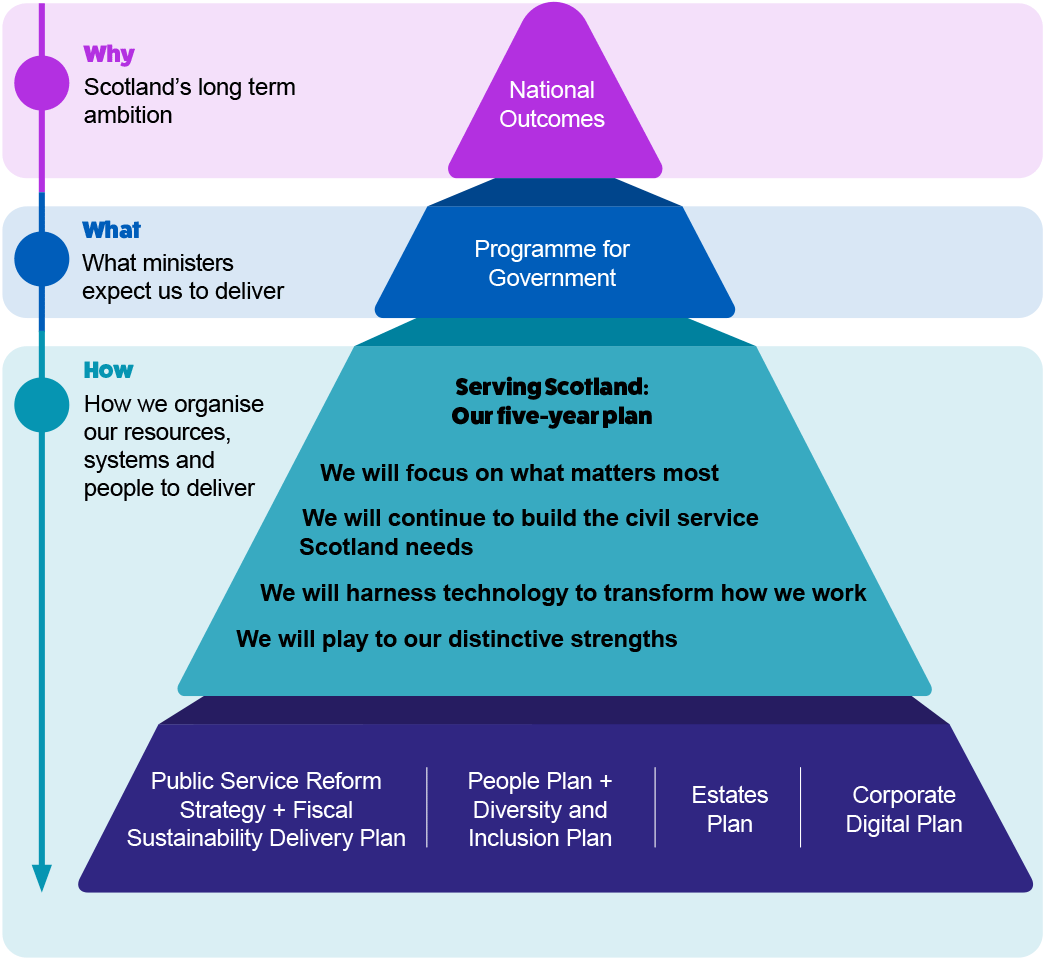
Scotland’s National Outcomes set the ambition for our country, and the Programme for Government sets out ministers’ priorities for delivering that ambition.
This plan explains how we will play our part. It sets out the change initiatives our organisation is taking forward, so we can work together to continuously improve how we serve Scotland.
There are four key areas where the Scottish Government can make the greatest difference:
- We will focus on what matters most
- We will continue to build the civil service Scotland needs
- We will harness technology to transform how we work
- We will play to our distinctive strengths
1 We will focus on what matters most
Our job is to take practical action to improve people’s lives. Delivery of ministers’ priorities must be our relentless focus. Everything we do should be judged against the difference it makes.
How we use our budget on behalf of ministers and the people of Scotland is critical to delivering impact.
Being a smaller, more focused organisation will help us do this well. We will direct resources to where they can achieve the greatest good, use evidence to guide our choices and stop work that isn’t delivering enough value, so we can make space for what does.
We must adapt with agility. When priorities shift, we must respond and reallocate effort without being slowed down by process or structure.
This is how we will make delivery, not process, our defining purpose.
Our commitments
Being clear about priorities and progress
In 2026, we will work with ministers to establish a five-year Programme for Government, supported each spring by a 12-month delivery plan aligned to the Scottish Budget. This means commitments and resources will be confirmed together, giving us clearer priorities and a shared understanding of where to focus effort.
We will continue to improve how we track progress against Scotland’s National Outcomes. In 2026, we will establish a new system that gives us access to more detailed information on what’s working and where we need to change, strengthening the support we give Ministers to report progress to Parliament.
By 2027, we will establish a Corporate Change Portfolio Group to bring stronger discipline and coordination to how we lead organisational improvement. It will advise the Executive Team on which improvement activity should proceed, pause or be reshaped, improving how we lead and manage change.
Managing money
Managing taxpayers’ money is one of our greatest responsibilities. Every pound we spend well is a pound that can improve lives across Scotland. We must ensure that as much of it as possible reaches the frontline of public services.
By 2027, we will be able to demonstrate with greater transparency how the Scottish Budget aligns with ministers’ priorities. This will include streamlined budget commissioning processes and a forward plan of fiscal events.
By 2027, we will have reviewed our finance operating model to improve consistency and automation across finance activities. We will enable technology on Oracle Cloud that provides finance professionals, managers and leaders with better data to inform decisions.
By the end of 2028, our finance profession will be further strengthened to oversee and maintain the revised finance operating model. This will improve professional standards, career development and learning for the finance community and enhance the support provided to the wider organisation to drive value.
Our Centre of Expertise in Appraisal and Evaluation will help ensure spending decisions are better evidenced through targeted use of appraisal and evaluation. By 2028, we will have undertaken a series of value for money reviews across key areas of spend, providing robust analysis and practical recommendations to inform a future Scottish Spending Review.
Working with Public Services Delivery Scotland, we will offer shared corporate services and technology to smaller public bodies. This will include our Oracle Cloud and audit functions, which are already provided as shared services for other parts of the public sector. We will invest the money saved into delivery of frontline services.
The size and shape of our workforce
Our professions are one of our greatest strengths. The depth of skill and expertise across our organisation underpins everything we deliver for ministers and the people of Scotland. As we shape our workforce for the future, we will continue to invest in that expertise, ensuring it grows even as our overall size changes.
To date, we have reduced the size of our workforce largely through natural attrition and tight recruitment controls. This is a significant achievement, and a sign of what we can do when we focus.
We will explore further ways to achieve the right size and shape for the organisation, engaging with our trade unions. This may include, for example, a voluntary exit scheme, which would be developed with the engagement of trade unions, subject to ministerial approval, and communicated transparently to colleagues. This process of getting to the right size and shape will provide additional opportunities to colleagues for development, progression, and early career recruitment.
Deploying our resources
We will better prepare our people, resources and partnerships to enable more effective deployment of staff, using previous learning and insight to get ahead of emerging events. We will develop a clear, rehearsed guide for the Scottish Government which enables rapid mobilisation of resources to where they are needed most.
Compliance and standards
In 2026, we will implement more efficient ways of working with ministers. We will strengthen the standards that underpin the advice we provide, drawing on our professions’ expertise and strong use of evidence to ensure that submissions, Cabinet papers and correspondence are consistently high-quality and focused.
By 2027, we will deliver a new correspondence, Parliamentary Questions and Freedom of Information system to support this.
What this means for you
You will have a stronger understanding of ministerial priorities and a clearer picture of how the organisation is performing against them.
Our organisational change efforts will be more coordinated and joined up.
As we become smaller, this will be a more connected, less bureaucratic organisation and a better place to work. You will have more efficient systems and processes in place and will spend less time on work that doesn’t add value.
2 We will continue to build the civil service Scotland needs
We will build an organisation that is not only smaller, but more capable, more skilled, and better equipped to deliver for the people of Scotland.
You will have the right skills, support and opportunities to do your best work. We are committed to ensuring everyone has a fair chance to contribute and progress.
We will strengthen our core skills, building on the findings of our Capability Review, and make the most of our professions to connect colleagues across the organisation. We will ensure performance and development conversations are consistent and honest, and invest in your wellbeing and development.
How and where we work matters. Devolution brings government closer to the people it serves. Civil servants working face to face with partners wherever possible, getting out into communities, understanding the impact of public services in practice is central to this.
Our commitments
Diversity and inclusion
Being able to attract and retain the best talent is key to serving Scotland well. Our organisation should reflect the diversity of the population we serve, and we are committed to creating, together with our staff networks, an environment where all of our people can flourish.
In 2027, we will publish a refreshed Diversity and Inclusion Action Plan to 2030, using diversity data to target the systems, processes and behaviours that get in the way, so that everyone can thrive.
In 2026-2027, we will introduce anonymised sifting to reduce bias in hiring and investigate barriers facing colleagues from lower socio-economic and minority ethnic backgrounds. We will rebuild our diversity data to improve decision-making, so that everyone has a fair and equal chance to join and progress within the organisation.
Skills and capability
In 2025-2026, we conducted a self-assessment of the maturity and consistency of skills across the organisation in three key areas: digital, policy delivery, and core civil service skills. This Capability Review now gives us clear evidence on where our skills need to strengthen. The following commitments respond to that evidence.
By the end of 2027, our professions will set out what good skills and performance look like in different roles, improving learning, career pathways, and how we deploy expertise.
By the end of 2028, we will invest more in leadership and management development at every level.
By the end of 2028, we will have clear standards for our core skills, with new opportunities to develop them.We will improve the design and implementation of policy delivery through better use of data and evidence, and cross system collaboration.We will improve digital and data skills across all professions, strengthening our confidence to innovate.
Management, leadership and performance
Monthly conversations between colleagues and managers give us a strong foundation of regular contact and feedback to build on.
In 2026, we will reset expectations for senior leaders, with greater focus on working across organisational boundaries, innovation, professional excellence and inclusive leadership.
By mid-2027, we will review and reform our performance management framework and consult our trade unions. We will benchmark this against high-performing organisations to strengthen accountability.
Between 2028 and 2030, we will embed this new approach, building a culture where regular feedback and coaching is driving performance. This means recognising and rewarding strong performance, and better equipping managers to tackle poor performance head-on, with clear next steps if things do not improve.
Higher standards, better experience for all
In 2026, we will set out clearly what working for the Scottish Government offers to staff, and what is expected in return, in our employee value proposition.
In 2026, we will better equip line managers to identify and act on team wellbeing concerns, particularly during periods of change. We will also publish a reasonable and workplace adjustments policy, giving colleagues clearer routes to the right support.
Every year to 2030, we will strengthen the training and tools available to line managers, so they are better equipped to support their teams’ wellbeing.
Too many working days are currently lost due to sickness absence. We are committed to reducing this whilst ensuring we effectively support staff who are absent. Line managers play a critical role in identifying issues early on and supporting their teams. We will deliver a range of learning products between 2026 and 2027 to equip managers to meet the expectations set by our attendance management policy. A revised attendance management policy will follow in 2027. We will monitor changes as we work to reduce sickness absence levels and enhance organisational performance.
Each year, we will continue to reduce the number of line managers across the organisation, increasing spans of control, working towards an optimal management structure, and providing more focused investment in their development. We will improve job design so that roles are more stretching, deliverable and rewarding.
We have already begun work on refreshing our People Plan, and will publish an updated version by March 2027, focusing on practical steps that directly support this five-year plan.
How and where we work
Modern technology offers great opportunities and can support a better balance between work and personal life. At the same time, we undoubtedly benefit from being able to spend time together in person, with stakeholders and in communities.
We will explore further ways to achieve the right size and shape for the organisation, engaging with our trade unions. This may include, for example, a voluntary exit scheme, which would be developed with the engagement of trade unions, subject to ministerial approval, and communicated transparently to colleagues. This process of getting to the right size and shape will provide additional opportunities to colleagues for development, progression, and early career recruitment.
In 2026, we will formally consult with unions to take stock of the implementation of the current hybrid working policy, using data, and propose potential improvements. This will help to ensure hybrid working is happening consistently and credibly in practice.
From 2026, we will begin the roll out of a new desk and facility booking system to better support hybrid working.
In early 2027, we will publish a location policy that balances business needs with flexibility and inclusion.
By the end of 2027, we will have a single support model for all estate-related queries and a standard kit offering to support effective hybrid working.
We also want our buildings to work harder for us, providing spaces that meet the needs of our people and support our wider environmental commitments.
Our estate reduction programme has closed 14 buildings since 2023. By early 2027, we will publish a forward plan of estate change projects to 2032 that will result in a smaller and more fit for purpose estate. This will be accompanied by a Best Practice Design Guide which sets the standards for all building refurbishments, helping to ensure our spaces are accessible, inclusive and fit for modern working.
By 2027, we will have published a Climate Action Plan setting out how we will reduce estate emissions and improve energy efficiency by 2030.
What this means for you
You will work in an organisation that is actively removing barriers to inclusion and ensuring that as we change, no one is disadvantaged.
You will have a better understanding of what’s expected of you in your role. You will have clearer career paths, better development opportunities, and regular, honest conversations with your manager about your performance and future. You will have clearer expectations about where and how we work; well-maintained, accessible workplaces; and equipment that supports collaboration wherever you are based.
If you need adjustments to how or where you work, you will be actively supported to participate fully and stay connected to your team and the wider organisation.
3 We will harness technology to transform how we work
Technology and data should make work easier, freeing you to focus on the thinking, craft and action that only you can bring.
New technology, particularly AI, is creating opportunities to transform how we work at a pace and scale we haven’t seen before. Of course, alongside these opportunities come risks, and we must manage them responsibly as we go further, faster.
Technology cannot replace people. But used well, it can help you to do your best work.
This could mean, for example, using AI to support minute-taking, to help prepare internal briefings, or to handle correspondence, Parliamentary Questions and Freedom of Information requests more efficiently.
Our commitments
In 2027 we will publish our corporate digital plan, setting out our full phased programme of change to modernise our internal IT systems.
Better tools and infrastructure
In 2026, we will make the capabilities of Copilot Premium and Power Platform available across the Scottish Government, and provide learning and support to help colleagues to use AI responsibly and effectively.
Starting in 2026, we will develop and deploy AI agents that can assist colleagues with tasks, access information and interact with business systems through secure and governed digital platforms.
Smarter, more automated working
From 2026, we will scale the responsible and ethical use of AI, automation and work redesign across Scottish Government operations. By 2030, these capabilities will be part of how we work, reducing administrative burden, supporting better decisions and freeing colleagues to focus on work that makes the biggest difference. Our AI and Automation Centre of Excellence will enable, coordinate and govern this work, turning what works into shared, reusable services across the organisation.
In 2027, we will replace the Staff Directory with a new Oracle Cloud solution, giving colleagues a more reliable and better-integrated way to connect with each other.
In 2027, we will introduce Oracle Cloud Helpdesk self-service tools to make it easier to get support with HR queries and self-serve where appropriate. We will also replace iFix with a new IT service desk, making it easier to get IT support.
Secure and resilient systems
By 2027, we will achieve Cyber Essentials Plus certification and compliance with the UK Government’s Cyber Assessment Framework, giving our organisation and partners greater assurance about our shared infrastructure. In doing so, we will help set the standards that support safe and effective delivery of AI and digital services across the public sector, using technology to enable economic growth.
What this means for you
You will have access to better tools, backed by learning materials and support to help you use AI confidently in your role. You will spend less time on repetitive, low-value tasks and more time on work that needs your judgement and expertise.
4 We will play to our distinctive strengths
Devolution in Scotland has evolved significantly since 1999, and the relationships that shape how we work have evolved with it.
We have the opportunity to build on distinctive relationships with local government, the third sector, business and communities across Scotland, and work collaboratively rather than in silos.
This is central to our role in public service reform. We must work with partners to design and deliver services around the needs of the people who use them, rather than the structures of individual organisations. We must be outward-facing and curious, always looking to learn from others and to bring the best ideas into our work.
Scotland's scale is an advantage. Our country is small enough that we can work closely together, and large enough that this collaboration has real impact. This scale also gives us the ability to move quickly. We can respond to events and reprioritise faster than much larger governments, because the distance between decision and delivery is shorter.
Economic growth is central to the government's mission, and we have a direct role in supporting it. That means using our strengths well: working closely with businesses and investors, being a good partner to the organisations that deliver growth on the ground, and making sure our own policies and processes don’t get in the way of the outcomes ministers want to see.
None of this works without you. You are our greatest strength, bringing skill, insight and a genuine commitment to improving lives across Scotland.
Our commitments
Listening to you
We will introduce a new way for colleagues to propose and implement improvements to ways of working.
We will build on the contribution of our modern apprentices, graduate trainees, and all our leaders of the future – ensuring the organisation continues to benefit from new skills, fresh thinking and diverse perspectives.
Connecting with communities
We will make the most of Scotland’s scale, ensuring our teams regularly meet stakeholders and spend time in the communities we serve, so policy is shaped by a first-hand understanding of how it lands in practice.
In 2026, working with a range of public service leaders and with the Scottish Leaders Forum in support of the Public Service Reform Strategy, we will publish a shared statement on good public service leadership. It will emphasise the importance of a whole-system, whole-place mindset; building trust and enabling candour; valuing learning, foresight and innovation and modelling shared values and accountability.
By 2027 we will strengthen the role of Place Directors, who provide every part of Scotland with a senior point of contact to understand local priorities, so they can connect communities even more directly to government.
We will make more active use of our convening role, bringing together partners from the public, private and third sectors to lead out public service reform.We will continue to improve how we meaningfully engage the public in the development of policy in line with our Open Government Action Plan.
We will take an audience-first approach to reach the public more directly and more often with essential government messages, using paid, earned, shared and owned communications. We will continue to review and refine our digital communications activity, to tell the story of government to Scotland’s people in the most effective way.
Working flexibly and efficiently
We will share our buildings with our partners where it makes sense to do so, ensuring our physical locations support strong local relationships as well as agile working.
We will strengthen our Directors’ Network and use our Senior Civil Service events to strengthen cross-government working in practice.
What this means for you
You will have more opportunities to contribute your ideas and shape improvements, whatever your role or level in the organisation. You will be part of a more outward-facing organisation, with stronger connections into local communities and the partners we work with.
Contact
Email: PermanentSecretary@gov.scot