
Scottish Income Tax and Businesses: Initial Evidence Review of Tax and Competitiveness
This report reviews evidence on how Scottish Income Tax policy may influence businesses and Scotland’s economic competitiveness. It examines potential effects on labour costs, recruitment and retention, migration, business behaviour and investment, drawing on research, surveys & business interviews.
1. Introduction
The Scottish Income Tax system has undergone significant reforms since its introduction in 2017-18. This has delivered a more progressive system than elsewhere in the UK while raising additional revenue for vital public services.
These reforms to Scottish Income Tax have taken place against a period of change in the UK tax system. The IFS have noted that the period between 2010 and 2024 was characterised by big swings in the direction of UK tax policy[1]. Many of these changes related to taxes paid directly by business. Examples include the lowering and subsequent raising of the main rate of Corporation Tax, while more recently Employers National Insurance Contributions (NICs) have increased.
The Business Insights and Conditions Survey (BICS) shows that taxation is now among the most prominent main concerns for businesses. Figure 1 shows results for August 2025 consistent with the end of the period over which external research from the IFF was being carried out[2]. Taxation and business rates are just below falling demand of goods and services for those businesses having concerns (with taxation and business rates remaining the second most reported main issue in Scotland in the latest BICS - at the time of writing this was May 2026[3]). Its greater importance has been a feature across other business surveys including the latest Small Business Survey[4].
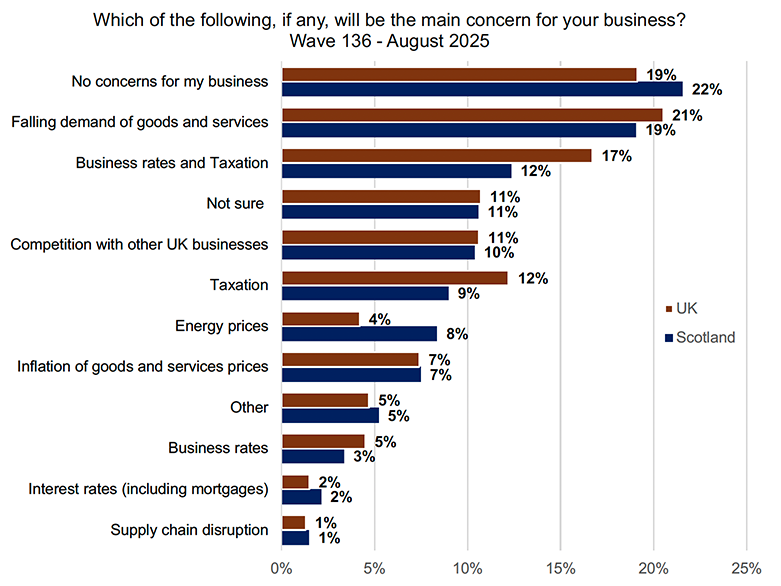
Source: Business Insights and Conditions Survey, Wave 136
Scotland’s Tax Strategy[5] announced an intention not to introduce new bands or increase rates of Scottish Income Tax up to the end of the last Parliament, signalling a period of stability and to allow for the impacts of recent policy changes to be assessed. The SNP manifesto reflected a continuation of these priorities, with an ambition to make the system simpler by the end of the next Parliament.
Significant progress has been made in recent years to enhance the evidence base available to inform Income Tax policy. However, to date this has focussed on how individual taxpayers respond to changes to Scottish Income Tax policy. That is why the Tax Strategy set out a priority “to broaden our understanding on how the tax environment impacts on the competitiveness and attractiveness of Scotland’s Economy” and publish an initial evidence review on this topic[6].
This paper fulfils this commitment, summarising an initial review of the evidence and setting out priorities for future work. It seeks to explore the ways in which Scottish Income Tax policy may affect businesses in Scotland, and by extension the competitiveness of the Scottish economy. The paper draws together three strands of evidence:
- A literature review on the mechanisms by which businesses may be affected by changes to personal tax policy.
- Analysis of the Business Insights and Conditions survey, which covers both Scotland and the UK.
- Externally commissioned in-depth interviews with businesses across Scotland to add further depth to the insights from the above.
We consider different ways in which the Income Tax divergence could affect business outcomes. While we can infer the importance of different taxes up to a point, the most important factors driving labour costs and recruitment difficulties; or what businesses mean by competition with other businesses requires another approach. In order to understand more about these, the Scottish Government commissioned IFF Research to undertake in-depth individual interviews with businesses. In order to understand more about these, the Scottish Government commissioned IFF Research to undertake in-depth individual interviews with businesses. Read the full IFF Research report on business interviews. We then conclude and consider possible next steps.
Box 1: Interviews with Scottish businesses
Scottish Government commissioned IFF to conduct a series of detailed interviews with businesses across Scotland. The intention of this was to gather in-depth understanding of how individual businesses had reacted to previous changes to Income Tax policy. The fieldwork took place between 21 May and 21 July 2025.
IFF were tasked with conducting interviews with businesses from a range of sizes and sectors. They approached 2,687 businesses of which ultimately 27 took part in interviews lasting approximately 60 minutes. Interviews covered a range of topics including how businesses viewed competitiveness and the impact of wider macroeconomic factors on their operations before entering into the impact of tax policy. A general finding was that the businesses interviewed needed to be prompted to consider the role of Scottish Income Tax on competitiveness, suggesting it was not a priority concern for those taking part in the research.
The findings of this strand of research are not intended to be representative or generalisable across the Scottish business base. Rather, the interviews provide a level of depth not provided by either the academic literature or business surveys. In this way, they provide an important supplement to these sources of evidence to help enhance our understanding of how Scottish businesses have reacted to changes to Scottish Income Tax policy.
Contact
Email: Lorraine.king@gov.scot