
Mental Health and Wellbeing Delivery Plan
The Mental Health and Wellbeing Delivery Plan sets out our priorities and actions to help us achieve our vision of a Scotland, free from stigma and inequality, where everyone fulfils their right to achieve the best mental health and wellbeing possible.
Prevention and the Social, Economic and Environmental Determinants of Mental Health
Across this plan we reference prevention. This is informed by a public health approach to prevention – activity that aims to stop the establishment or escalation of problems that lead to negative outcomes for people. In doing so, prevention improves lives and reduces acute demand.
Actions across this plan span all types of prevention:
Primary prevention: Investing in the building blocks of health to stop problems happening in the first place.
Secondary prevention: Targeted action to identify and respond to early signs of a problem to prevent escalation and reduce levels of harm.
Tertiary prevention: Intervention once there is a problem to stop it from getting worse or recurring in the future reducing levels of harm.
This focus on prevention also aligns with the First Minister's priorities and the Verity House Agreement and this plan will contribute to the shared commitments of the Scottish Government and COSLA to:
- tackle poverty
- transform our economy
- deliver sustainable person-centred public services.
We know there are many other issues that affect peoples’ lives and mental health and wellbeing, such as substance use issues, poverty, unemployment or homelessness. We also recognise people in contact with the justice system are more likely to have experience of these issues as well as trauma, adverse childhood experiences and social exclusion. Mental health support for individuals should be connected across health, social care, housing and justice services to ensure people receive joined up care and support, regardless of where they first encounter services.
There is a profound two-way link between mental health and poverty. Adults living in Scotland’s most deprived communities are twice as likely to experience anxiety or depression and rates of suicide in the most deprived communities are 2.5 times higher than those from the least deprived areas[2].
That is why preventative mental health and whole system approaches make an important contribution to tackling child poverty and have particular benefits for families affected by poverty.
We also know that employment status is linked to mental health outcomes, with those who are unemployed or economically inactive having higher rates of poor mental health than those who are employed[3]. Supporting good mental health and wellbeing is important in helping parents and carers access and sustain employment, but also to engage with the wider drivers of poverty reduction.
"Being part of DEAP means my experiences of being a single parent, navigating poverty, unemployment and years of studying are not heard once and then forgotten, but are built into how this strategy gets delivered, year on year. Nobody has really valued those experiences before, and that means a lot to me. But it only works if lived experience stays at the table, not just at the launch." - Jen, DEAP Panel Member
Delivering the actions in this plan will require continued working across government to ensure mental health and wellbeing impacts are considered at the earliest stages of policy development across actions on social determinants and throughout implementation. Within this plan we have specific actions on social determinants including housing and employability where there are both risks and protective factors in relation to mental health and current opportunities for action. However, we will also continue to make appropriate links to wider areas of work.
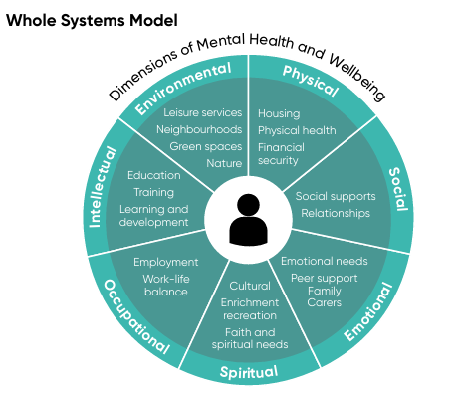
Whole Systems Model
Dimensions of Mental Health and Wellbeing
Environmental
- Leisure
- Neighbourhoods
- Green spaces
- Nature
Physical
- Housing
- Physical health
- Financial security
Social
- Social supports
- Relationships
Emotional
- Emotional needs
- Peer upport
- Family
- Carers
Spiritual
- Cultural
- Enrichment recreation
- Faith and spiritual needs
Occupational
- Employment
- Work-life balance
Intellectual
- Education
- Training
- Learning and development