
Agricultural Household Survey 2025 Report
Results from the Agricultural Household Survey 2025
3. Equalities profile
3.1 Introduction
This chapter presents an analysis of equalities data collected through the AHS, focusing on key demographic and identity characteristics such as disability and mental health, marital status, religion, sexual orientation, trans status, and ethnicity.
Throughout this section we refer to “active farmers or crofters”. These are respondents who described their role on the farm as being farmers or crofters, farm or croft business owners, business partners, junior partners or paid workers on farm or croft. Where available, active farmers have been compared to the 2022 Census data on the Scottish population overall and those working in agricultural occupations.
Differences between the AHS and Census with respect to characteristics such as religion, marital status and sexuality may be due to the older profile of the AHS population compared to the Census population.
3.2 Disability and mental health
Around one in five active farmers overall had a health condition or disability that limits their day-to-day life (19%), which was lower than the data derived from the 2022 Scottish Census for those in agricultural roles (27%) and also for the Scottish 18+ population overall (28%). Please note the Scottish Census data for Scotland is shown for each of the equalities questions on the basis of the adult population aged 18 and over to ensure compatibility with the AHS where survey respondents had to be aged 18 and over.
|
Census 2022 Scotland |
Census 2022 – Agricultural occupations | All AHS respondents | AHS respondents – active farmer/ crofter | AHS respondents - Non active farmer/ crofter | |
|---|---|---|---|---|---|
| Yes - have a disability/ mental condition that affects day-to-day life | 28% | 27% | 20% | 19% | 22% |
| Do not have a disability/ mental condition | 72% | 73% | 80% | 81% | 78% |
| Total | 100% | 100% | 100% | 100% | 100% |
| Base | 4,435,525 | 35,195 | 3,837 | 3,351 | 486 |
Where active farmers had a disability or health condition they were asked to describe the nature of their condition(s) from a list of options. Respondents were able to select more than one option and were most likely to say they had a condition that affects their mobility (45%) or stamina, breathing or fatigue (26%). A full list of the nature of the condition is shown in Table 3.2.
It should be noted that where respondents mentioned “other conditions” this was often chronic conditions such as arthritis, asthma or diabetes. Active farmers were more likely to mention mental health conditions (18%) than non-active farmers (10%).
| All AHS respondents | Active farmer/ crofter | Non active farmer/ crofter | |
|---|---|---|---|
| Mobility (for example walking short distances or climbing stairs) | 46% | 45% | 54% |
| Stamina or breathing or fatigue | 27% | 26% | 31% |
| Hearing (e.g. deafness or partial hearing) | 21% | 20% | 26% |
| Mental health | 17% | 18% | 10% |
| Dexterity (e.g. lifting or carrying objects, using a keyboard) | 14% | 14% | 11% |
| Dyslexia or dyspraxia | 10% | 10% | 6% |
| Vision (e.g. blindness or partial sight) | 9% | 9% | 7% |
| Memory | 8% | 8% | 9% |
| Socially or behaviourally (E.g. ASD incl. Aspergers, ADHD)) | 6% | 6% | 3% |
| Learning or understanding or concentrating | 5% | 6% | 3% |
| Wheelchair user | 2% | 2% | 2% |
| Loss of limbs | 1% | 1% | 3% |
| Other | 19% | 21% | 12% |
| Prefer not to say | 6% | 6% | 6% |
| Base | 770 | 647 | 105 |
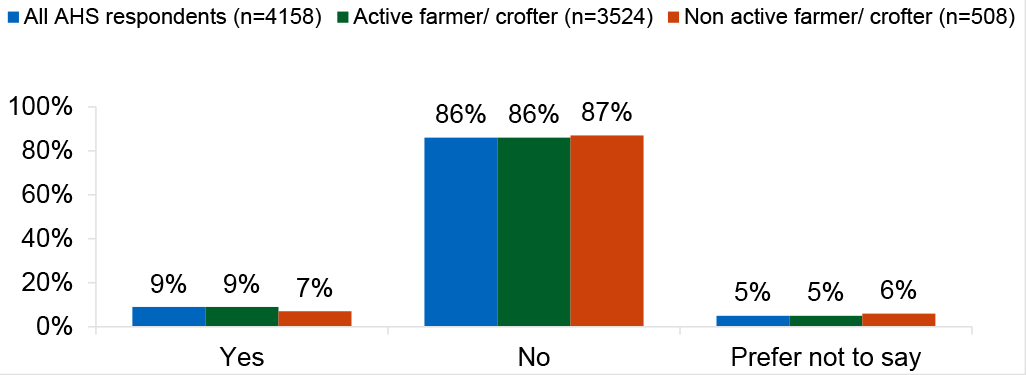
Just under one in ten active farmers (9%) had sought help for a stress, emotional or mental health problem in the last 12 months, 86% said they had not done this and 5% refused to say. The Health and Care Experience Survey for 2023/24 identified that 10% of respondents said that the last time they had contacted their General Practice to receive treatment or advice this had been regarding a mental health problem. Active farmers were not more or less likely to have sought help in this respect than other respondents.
Respondents aged 60 or older were least likely to have reached out for help (7%, compared to 12-13% for younger age groups). Female respondents were also more likely to have sought help (13%) than male respondents (8%).
Where active farmers had sought help, they were most likely to have approached their GP (63%), followed by friends and family (42%).
| All AHS respondents | Active farmer/ crofter | Non active farmer/ crofter | |
|---|---|---|---|
| GP | 64% | 63% | 75% |
| Rural Mental Health Forum | 2% | 2% | 3% |
| Friends and family | 40% | 42% | 25% |
| RSABI | 6% | 7% | - |
| Action support services | 4% | 4% | - |
| Counsellor/ therapist | 5% | 6% | - |
| Alternative/ holistic therapies | 1% | 2% | - |
| Physical wellbeing/ physiotherapy/ gyms etc | 1% | 0% | - |
| Farm Talk | 1% | 1% | - |
| Farmstrong | 1% | 1% | - |
| Psychiatrist/ psychologist | 1% | 1% | 3% |
| Church | 1% | 1% | - |
| Other organisation | 10% | 10% | 11% |
| Prefer not to say | 5% | 4% | 6% |
| Base | 368 | 321 | 36 |
All respondents were asked what sources they would suggest to others if they were in need of support. Seven in ten respondents (69%) said they would suggest contacting their GP, 54% would recommend reaching out to friends and family, and 31% would suggest contacting RSABI. This is a much higher proportion than the 6% who had contacted RSABI where they had experienced a stress, emotional or mental health problem.
Analysis of sources that would be recommended shows that active farmers were more than twice as likely to suggest contacting RSABI (33%) than non-active farmers (15%). As age increases, the proportion of respondents who would suggest contacting a GP also increases, while suggesting contacting friends and family decreases with age.
| All AHS respondents | Active farmer/ crofter | Non active farmer/ crofter | |
|---|---|---|---|
| GP | 69% | 69% | 66% |
| Friends and family | 54% | 55% | 44% |
| RSABI | 31% | 33% | 15% |
| Rural Mental Health Forum | 14% | 14% | 13% |
| Don't know | 12% | 11% | 20% |
| Action support services | 5% | 5% | 4% |
| Other organisation (please write in) | 2% | 2% | 3% |
| Samaritans | 1% | 1% | 0.2% |
| Farmstrong Scotland/ Farmstrong | 1% | 1% | 0.2% |
| Counsellor/ therapist | 0.3% | 0.3% | - |
| Church/ religious organisation | 0.2% | 0.3% | - |
| Don't know | 12% | 11% | 20% |
| Base | 4114 | 3497 | 495 |
3.3 Marital status
Just over seven in ten active farmers (71%) were married or in a registered civil partnership, 15% were never married and never registered in a civil partnership, 7% were widowed or surviving a partner, 5% were divorced or formerly in a civil partnership which is now legally dissolved, and 2% were separated but legally still married or in a civil partnership. The proportion of active farmers who were married or in a civil partnership was much higher than for people identified through the 2022 Census who were in agricultural occupations (55%) or for the Scottish population overall (45%).
|
Census 2022 Scotland |
Census 2022 – Agricultural occupations | All AHS respondents | AHS respondents - active farmer/ crofter | AHS respondents - Non active farmer/ crofter | |
|---|---|---|---|---|---|
| Never married and never registered in a civil partnership | 37% | 29% | 15% | 15% | 11% |
| Married / In a registered civil partnership | 45% | 55% | 71% | 70% | 74% |
| Separated, but still legally married/ in a civil partnership | 3% | 2% | 2% | 2% | 1% |
| Divorced/ Formerly in a civil partnership which is now legally dissolved | 9% | 6% | 5% | 5% | 4% |
| Widowed/ Surviving partner from a civil partnership | 7% | 9% | 7% | 7% | 10% |
| Other | - | - | 0% | 0% | - |
| Total | 100% | 100% | 100% | 100% | 100% |
| Base | 4,435,525 | 35,195 | 4,019 | 3,422 | 492 |
3.4 Religion
When asked about religion, a third of active farmers (33%) said they did not belong to any religion or faith. Half (50%) said they were Church of Scotland, 12% were other Christian and 3% were Roman Catholic.
Comparison to the Census reveals that active farmers were less likely to have said they did not have a religion or belief (33%) than people identified through the 2022 Census who were in agricultural occupations (41%) or for the Scottish population overall (52%). There is some variation in the proportion of respondents who are Church of Scotland or Roman Catholic compared to the 2022 Census.
| Census 2022 - Scotland | Census 2022 - Agricultural occupations | All AHS respondents | AHS respondents - active farmer/ crofter | AHS respondents - Non active farmer/ crofter | |
|---|---|---|---|---|---|
| None | 52% | 41% | 34% | 33% | 38% |
| Church of Scotland | 24% | 49% | 49% | 50% | 44% |
| Roman Catholic | 14% | 4% | 3% | 3% | 4% |
| Other Christian | 6% | 6% | 12% | 12% | 13% |
| Muslim | 2% | 0.2% | 0.1% | 0.1% | - |
| Hindu | 1% | 0.0% | 0.1% | 0.1% | - |
| Buddhist | 0.3% | 0.1% | 0.3% | 0.3% | 0.2% |
| Sikh | 0.2% | 0.0% | - | - | - |
| Jewish | 0.1% | 0.0% | 0.1% | 0.1% | 0.2% |
| Pagan | 0.4% | 0.3% | 1% | 1% | 0.2% |
| Another religion | 0.3% | 0.2% | 0.4% | 0.3% | 1% |
| Total | 100% | 100% | 100% | 100% | 100% |
| Base | 4,164,845 | 32,999 | 3,964 | 3,367 | 479 |
3.5 Sexual orientation
Almost all active farmers who responded described their sexual orientation as heterosexual or straight (99%), 0.6% said they were gay or lesbian, 0.5% said they were bisexual, and 0.1% described their sexual orientation in some other way. This was similar to the Scottish population. Ninety-six per cent said they were heterosexual or straight in the 2022 Census and 99% for those in agricultural occupations.
| Census 2022 - Scotland | Census 2022 – Agricultural occupations | All AHS respondents | AHS respondents - active farmer/ crofter | AHS respondents - Non active farmer/ crofter | |
|---|---|---|---|---|---|
| Heterosexual/ Straight | 96% | 99% | 99% | 99% | 99% |
| Gay/ Lesbian | 2% | 1% | 1% | 1% | 0.4% |
| Bisexual | 2% | 1% | 1% | 1% | 0.4% |
| Other sexual orientation | 1% | 0.2% | 0.2% | 0.1% | - |
| Total | 100% | 100% | 100% | 100% | 100% |
| Base | 4,076,450 | 31,718 | 3,937 | 3,356 | 471 |
3.6 Trans status
Almost all active farmers said they were not trans (99.6%), this is consistent with the Census data for Scotland overall (99.5%) and for those in agricultural occupations (99.8%).
| Census 2022 - Scotland | Census 2022 - Agricultural occupations | All AHS respondents | AHS respondents - active farmer/ crofter | AHS respondents - Non active farmer/ crofter | |
|---|---|---|---|---|---|
| Yes - trans or trans history | 0.4% | 0.2% | 0.4% | 0.4% | 0.4% |
| No - Not trans and does not have trans history | 99.6% | 99.8% | 99.6% | 99.6% | 99.6% |
| Total | 100% | 100% | 100% | 100% | 100% |
| Base | 4,174,344 | 32,595 | 3971 | 3379 | 475 |
3.7 Ethnicity
Almost all active farmers described their ethnicity as “White” (99%), this is consistent with the Census data reported for all people in agricultural occupations (99%) – however, it is higher than the data reported for Scotland overall (94%).
| Census 2022 - Scotland | Census 2022 - Agricultural occupations | All AHS respondents | AHS respondents - active farmer/ crofter | AHS respondents - Non active farmer/ crofter | |
|---|---|---|---|---|---|
| White | 94% | 99% | 99% | 99% | 99% |
| Mixed or Multiple Ethnic Groups | 1% | 0.3% | 0.3% | 0.3% | 0.4% |
| Asian, Scottish Asian or British Asian | 4% | 0.4% | 0.1% | 0.1% | 0.2% |
| African, Scottish African or British African | 1% | 0.1% | 0.1% | 0.1% | 0.2% |
| Caribbean or Black (including Scottish Caribbean, Black Scottish) | 0.1% | 0.0% | 0.0% | 0.0% | - |
| Other | 1% | 0.2% | 0.2% | 0.2% | 0.2% |
| Total | 100% | 100% | 100% | 100% | 100% |
| Base | 4,435,525 | 29,600 | 4,054 | 3,439 | 497 |
Contact
Email: socialresearch@gov.scot